Tenzro is an economy for distributed compute and decentralized AI, open to machines of every size, from home nodes to data centers. It works alongside centralized data centers. They are not going away on this account: their operators are supply and customers of the same rails.
Tenzro was founded in 2024 with the vision of building a decentralized AI network, and the network launches now. That is the company history; what the network can do today is stated in the sections below, and the claims that depend on measurements are marked as not yet measured.
This post is about one narrow question: how capacity can be added when building new facilities takes time.
Context, with dates
A few dated facts, each from its source, about how new data-centre projects are going. They are context, not a forecast.
- On 4 November 2026 Fortune reported that voters sided against data-centre development in all but one of 38 local ballot contests, according to preliminary results compiled by Redbud Consulting. The same article cites Data Center Watch, a research project run by 10a Labs, for at least 45 projects worth roughly 68 billion US dollars disrupted by local opposition in the second quarter of 2026.
- On 5 November 2026 Fox Business reported S&P Global figures, as reported by The Washington Post, of more than 145 data-centre projects delayed or cancelled across the United States through early August, with public opposition blamed for most of them.
- On 21 September 2026 CBS Texas reported that the governor of Texas directed the state environmental regulator to halt permits sought by data centres while regulators audit the power and water they would use.
- On 10 August 2026 The Star, carrying Bloomberg reporting, said JPMorgan raised its 2026 forecast for technology, media and telecom debt issuance to 540 billion US dollars, with hyperscaler debt estimated at 317 billion and 85 billion from data-centre project financing.
On the demand side, Deloitte's 2026 predictions estimate that inference is about two-thirds of AI compute in 2026, up from about a third in 2023. That is Deloitte's estimate, and Deloitte also expects most inference to keep running in data centres and enterprise servers.
Taken together, new large facilities need land, local approvals, power interconnection, financing and construction, and the sources above describe delays in several of those. Compute that was planned for those facilities still has to run somewhere, and some of it may run on machines that already exist. This post does not predict how much.
What Tenzro does with machines that already exist
A node is software that runs on hardware you already own and host. It needs no new building, no land lease or construction permit for a facility, and no new grid connection. A billion-dollar campus needs all of those. Operators still follow their own local power, network, tax and business rules, and nothing here is an exemption from any of them.
The whitepaper, dated 1 October 2026, states the design: useful hardware sits in home PCs with a GPU, homelabs, independent data centres of every size, neo-clouds and existing data-centre fleets, and the Machine Economy needs a neutral way for that hardware to be discovered, priced, verified and paid.
What exists in the node today, described in How Tenzro distributes compute:
- A provider registry. Serving nodes announce their models and prices on signed gossip topics, and send a signed heartbeat every 2 seconds. A provider whose heartbeats stop for three intervals is treated as down.
- Routing. A caller can choose by lowest price, lowest latency, highest reputation, random, or a weighted score (the default), and can require a trust tier.
- Failover. The router can hedge a request to the next-best provider, and a multi-turn session can ask for a successor that holds its cache.
- Rented capacity. A renter opens a stream escrow to a compute provider. It accrues per epoch and pays only for epochs that validators judged the provider available. See Compute rental.
- Larger models. Mixture-of-experts models can be sharded across holders, and providers on one local network can pool into a pipeline for a model that does not fit one machine.
- One identity and one rail. One operator account, one hardware identity and one wallet can serve several roles, and the same account that serves work can buy it.
Starting with what you have
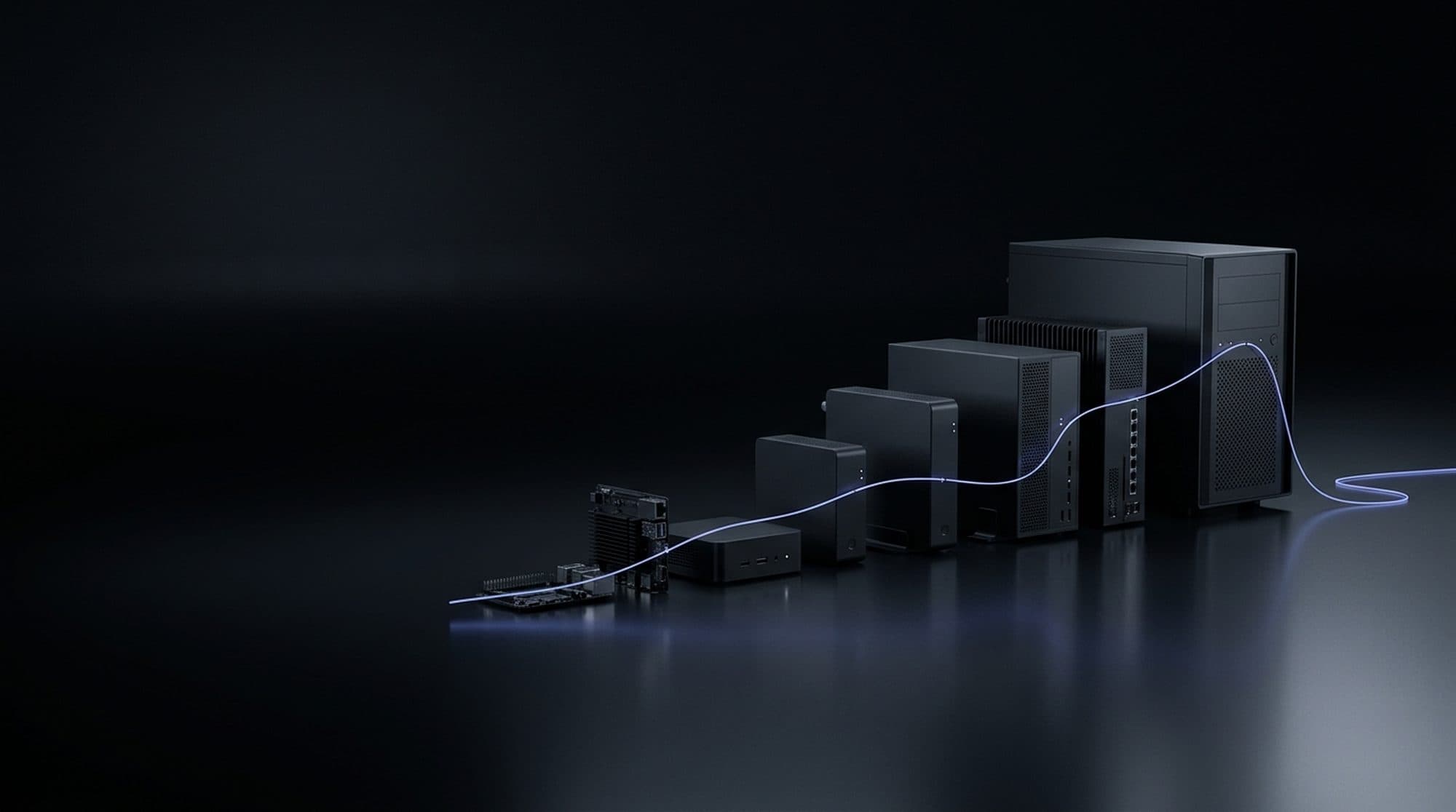
You can start with hardware you already own or can buy used, from a Raspberry Pi or a home computer to a repurposed server or workstation. What a machine can do depends on its CPU, memory, GPU and storage. The Supported hardware page lists which archives have passed an install gate and which classes are untested, and tenzro-node hardware checks a machine before anything is installed. Identity needs a TPM, a Secure Enclave or a delegated key holder.
The steps are: download and verify the archive, run the hardware check, provision the machine's key, then run tenzro setup. The documentation does not give durations for these steps, and neither does this post. Small and mid-size operators can begin with the stack they run and add roles later.
On energy, a device draws its own rated power. NVIDIA lists Jetson Orin Nano power options between 7 W and 25 W. Smaller devices run smaller workloads, data-centre hardware is often more efficient per operation, and overall energy depends on how much of the time a machine serves work. No claim is made here that distributed devices are more efficient, cheaper or greener per unit of work.
What is not proven
The network is in preview and has not yet carried production use. The design is tested by paid usage after launch, and this post is a description of what is built. Specifically:
- The orchestration role of small devices, and a single request that crosses tiers and is settled and paid, are designed but not yet measured on the launched network. Charter practice is to claim them only after measurement.
- That the largest models are served across machines is likewise not measured on the launched network.
- No cost, latency or capacity figure is given, and nothing here says that distributed machines replace data centres.
The economy is built around paid usage: fees are priced in USD, rewards follow paid, verified work, and supply follows usage. What the network does day to day does not depend on market sentiment.
Sources
- Fortune: After the midterms, Big Tech's AI data center problem is only getting bigger (4 November 2026)
- Fox Business: Voters reject data center expansion across US as AI industry faces growing backlash (5 November 2026), citing S&P Global figures reported by The Washington Post
- CBS Texas: Abbott takes additional steps to regulate data centers in Texas (21 September 2026)
- The Star (Bloomberg): JPMorgan sees tech bond sales surpassing half a trillion dollars in 2026 (10 August 2026)
- Deloitte: Why AI's next phase will likely demand more computational power, not less (TMT Predictions 2026)
- NVIDIA: Jetson modules (Jetson Orin Nano, power options between 7 W and 25 W)