GPU operators
12 articles
 Security
Securing the AI Model Supply Chain, From Weights to Serving
A model file is executable risk: it can carry code, be swapped in transit or be served by a machine that is not what it claims. A layered control set for model provenance, safe formats, signed releases and attested serving.
5 min read Confidential computing
Confidential Computing for Regulated AI: What Attestation Proves
TEE sessions and remote attestation let a regulated workload run on someone else's hardware with evidence of what code ran. What a report actually proves, what it cannot, and how Tenzro verifies, binds and routes confidential work.
5 min read Simulation
 and Digital Twins at Scale, Across Many Machines
Digital twins and robot-learning pipelines run thousands of simulations. Most of that work splits cleanly across many machines. How to decompose it, where it should run, and how to trust results computed on hardware you do not own.
4 min read Distributed training
Distributed Training Across Clusters: What Works Over the WAN Today
Low-communication training has moved from paper to practice, with models trained across continents and among peers who come and go. What the research shows, what still binds, and where an open network of verifiable machines helps.
4 min read Sovereign AI
EU AI Act, NIS2 and the Data Act: a guide for AI operators
Three EU laws now shape how AI infrastructure is run in Europe. This guide sets out the dates that apply after the 2026 Digital Omnibus on AI, the obligations that reach operators, and the evidence worth producing by default.
7 min read Distributed computing
From idle capacity to served inference: what operators need
Inference demand rises and falls through the day, so most AI capacity has spare hours. This article covers the five things a data-centre operator needs to sell those hours on an open network: machine identity, a trusted model supply, metering, proof of availability and direct settlement.
5 min read Generative media
Generative Media Pipelines: Right Hardware, Pay Per Result
Image, video and audio generation have cost profiles unlike chat. How to route each job to hardware that fits it, meter it in units that match the work, check licence territory and mark outputs for provenance.
5 min read Distributed computing
GPU operators: sell compute on verifiable service levels
Conventional cloud SLAs are measured by the provider, and the customer has to claim any credit. On an open market of independent GPU operators, availability and output have to be verified by someone else, and payment has to follow the verification. This article explains how that works and what it changes for operators.
6 min read Inference optimization
Inference Optimisation From Consumer GPUs to the Data Centre
Quantisation, speculative decoding, continuous batching, paged and reused KV cache, and prefill/decode disaggregation: what the 2025-2026 work shows, and what each technique means when the GPUs belong to many operators on a wide-area network.
6 min read Model routing
Model Ladders: Answer With Small Models, Escalate Only When Needed
Most requests do not need the largest model. What the research on cascades and routing actually shows, where it falls short, and how Tenzro routes by measured difficulty and closes the loop on escalation.
5 min read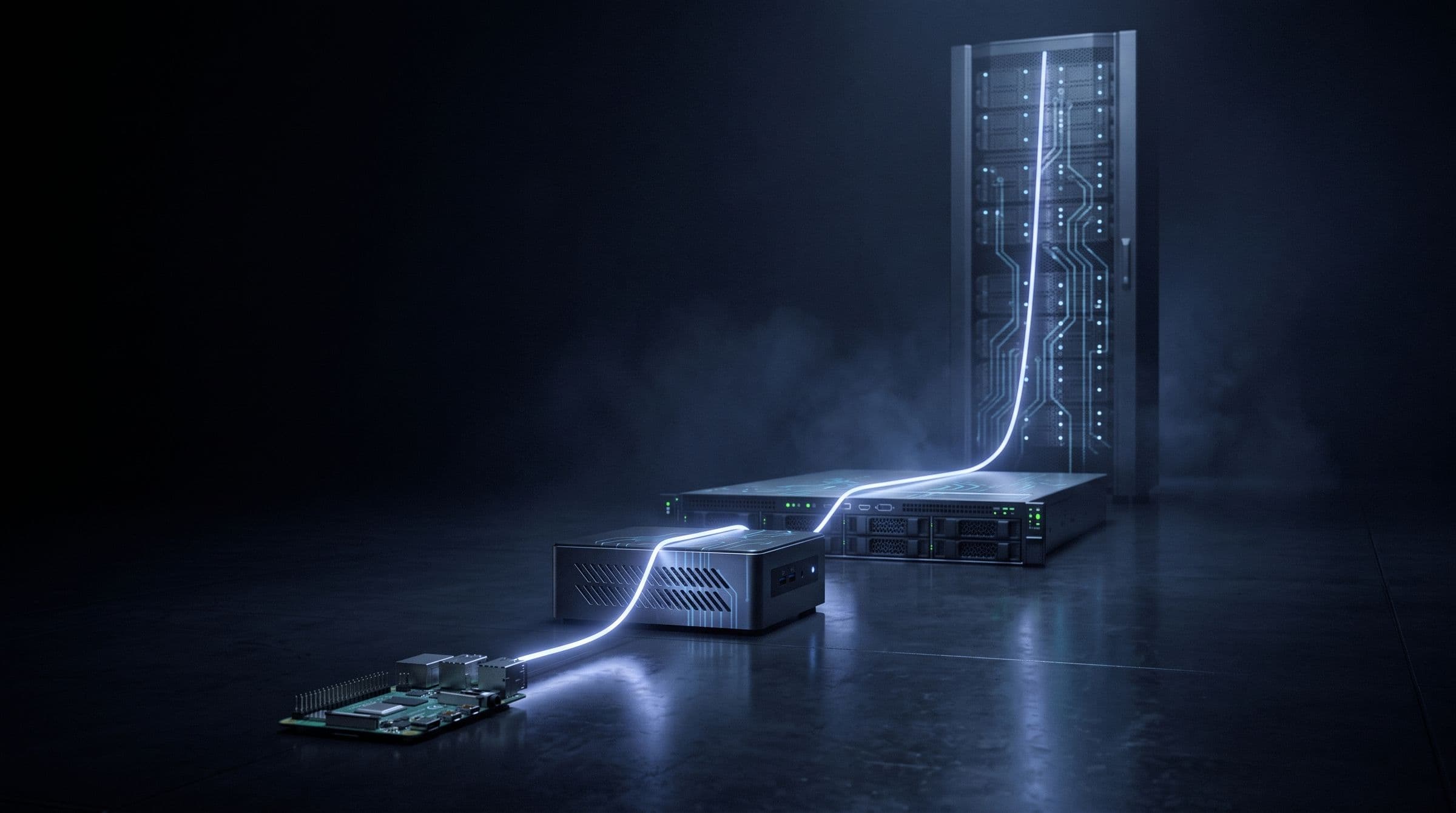 Edge AI
One Codebase From a Single-Board Computer to a Rack
Tenzro builds one node for every class of machine, from a Raspberry Pi to a GPU server, by varying compiled features and resource presets rather than forking the code. How the tiers work, what we measured, and why small devices belong in an AI network.
5 min read Model routing
Routing Across Many Providers, and Why Receipts Must Be Verifiable
A model router chooses on price, latency and standing, hedges the slow tail and fails over in seconds. None of that is trustworthy unless each answer comes with a receipt a third party can check. How Tenzro does both.
5 min read